For two weeks on eBay, we paid an ad fee on orders our ads had nothing to do with.
That is how Promoted Listings General works. It is an easy one to miss, and it is costing US and Canadian sellers money right now because the rule only changed there in January.
How Promoted Listings General actually charges you
General ads do not charge per click. eBay charges an ad fee on the sale, and the sale does not have to come from the click.
eBay’s own attribution page puts it plainly: a general campaign reports an attributed sale when a buyer purchases the same item that was featured in an ad any buyer clicked in the most recent 30 days.
Read that twice, because the consequence is not obvious.
- Buyer A clicks your promoted listing on the 1st.
- Buyer A never buys.
- Buyer B finds the same item organically on the 20th and buys it.
- The ad fee applies to Buyer B’s order.
One click makes the next 30 days of that item’s sales chargeable. The two people never have to be the same person, and the second one never has to see an ad.
There is one accuracy point worth keeping straight: an item that has never been clicked while promoted is not charged. So it is not literally every order. On any listing with real traffic it amounts to the same thing, because one click is a low bar.
What changed in January 2026
This attribution model reached the US and Canada on 13 January 2026. Other markets got it first: Germany in February 2025, then the UK, Australia, France, Italy and Spain in June 2025.
The stated ad rate did not go up. The share of orders carrying that rate did. Sellers in the markets that got it first reported attributed sales climbing to 80% or 90% of orders, against a much lower share before. Same percentage, applied to far more of the business.
If you set your General ad rate back when it only touched orders your ads clearly caused, that rate is now doing something different to your P&L than it was when you chose it.
Priority looks more expensive and costs less
We moved to Promoted Listings Priority. Priority charges per click, like every other ad platform you already run.
The attribution is also narrower. Direct attribution needs the same buyer who clicked to buy that same item. Halo attribution covers the case where someone clicks a promoted listing and then buys a different item from you, and on a halo sale you are still only paying for the click.
Priority looks more expensive at the start, because you now pay for clicks that do not convert and you can see every one of them. It cost us less than paying a percentage on sales the ads never touched.
That was one of four reasons our eBay channel closed at 20% net.
The other three reasons eBay closed at 20%
The referral fee is 15%, not 8%
Consumer electronics on eBay carries a 15% referral fee. The same category on Amazon is 8%. Seven points are gone before we have done anything at all.
This is the one nobody models before opening the channel. If you build your eBay pricing off your Amazon contribution margin, you are wrong by seven points on day one.
Fulfilled by merchant, with two-day shipping
The channel is fulfilled by merchant with two-day delivery, so we carry the shipping cost on every order. There is no FBA-style arrangement quietly absorbing it inside a fee you already accepted.
eBay buyers send offers, and a new seller accepts them
eBay buyers negotiate. That is the culture of the platform, and Best Offer is built into it.
We were new on the channel with no track record, so we accepted offers under list price to get orders moving. On a high priced product that is a real cut per unit, repeated across the month.
Stack all four together and 20% is what is left.
What 20% net looks like in dollars
June closed at $63,479 on an account that was doing nothing when we picked it up. Around $12,000 a month in net profit, on the same catalogue, with nothing new sourced, and a return rate lower than both Amazon and Walmart.
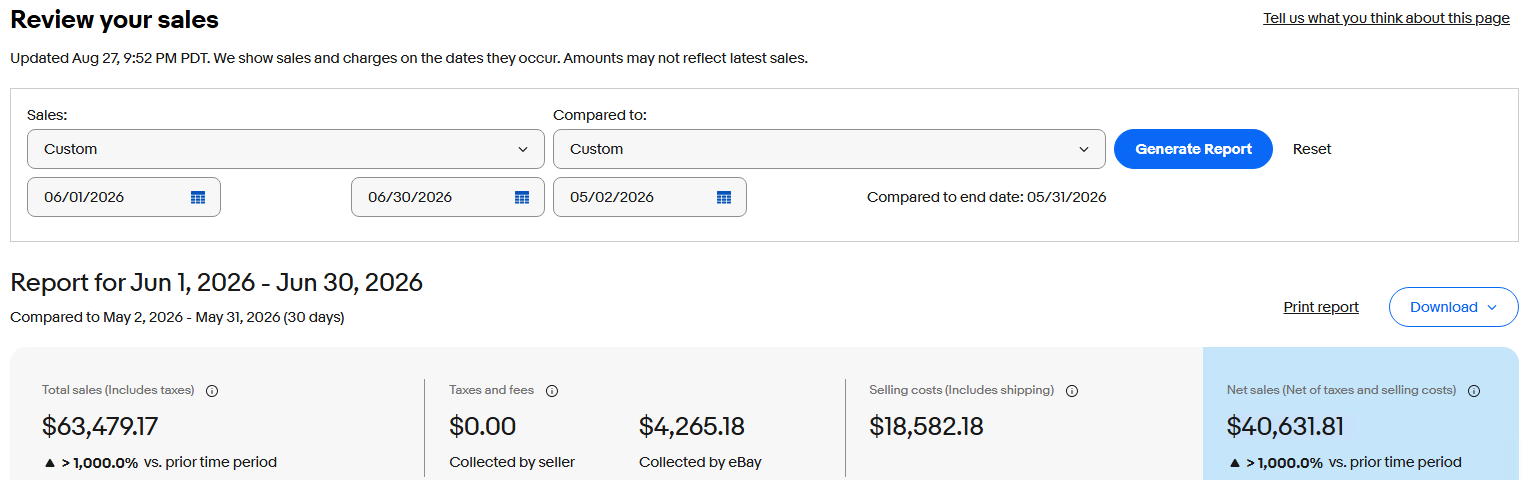 eBay's own report for the month. Note that eBay's "net sales" line of $40,632 is after its fees and the shipping we carry, but before cost of goods and before ads. The 20% is what survives all of it.
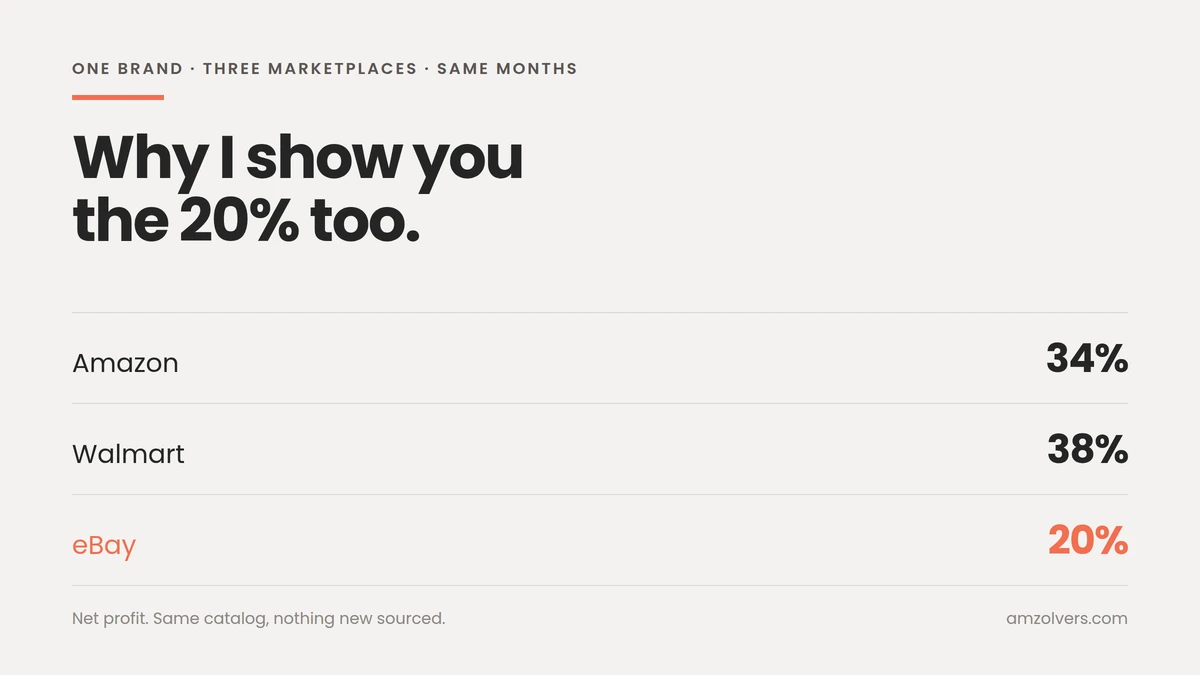
The same brand closed at 34% net on Amazon and 38% on Walmart over the same months. The full picture across all three marketplaces is in the case study.
I show the 20% for the same reason I show the other two. If every number in a case study is great, it is marketing.
So should you open eBay?
If you are already doing six figures a month on Amazon: yes, it is worth opening. We are keeping the channel.
Just plan for a lower margin than your other two channels instead of being surprised by it. Specifically:
- Price off eBay’s referral fee, not your Amazon one.
- Put shipping in the unit economics from the first day, not after the first month.
- Decide in advance how far below list you will go on offers, before you are the new seller who wants orders.
- Start on Priority rather than General, or at least know exactly what General is charging you for.
Twenty percent net on a third marketplace that did not exist four months earlier is a good trade. It is a bad surprise.
If you are running eBay, where does your net land?
Sources. eBay’s advertising attribution page for how General and Priority attribution differ. Value Added Resource for the 13 January 2026 US and Canada date and the earlier rollouts. Revenue, fee and margin figures are from an account we operate, shared with the brand’s permission.