There is a point in almost every growing Amazon account where the spend keeps going up and the revenue stops following. Nothing is broken. The ads are fine. You have simply bought most of the demand that already exists on the platform for what you sell.
Internal ads are a way of capturing demand. They are not a way of creating it. Once you own the top of search for your main terms, the only direction left is out.
What external traffic actually means
It means putting your product in front of people who were not searching a marketplace at all, then sending them to your listing. Four channels do most of the work:
- Creators on TikTok and Instagram. The strongest and the least predictable. One video that lands changes a month.
- Search engine ads. Google or Bing, pointed straight at the listing. Boring, controllable, and the one most sellers skip.
- Meta ads. Cheap reach, but you need a real offer and patience with attribution.
- Amazon DSP. Worth it once the account is large enough to feed it data.
What it returned on one account
A consumer electronics brand we run had a Walmart account sitting flat at around $5,000 a month. Internal ads alone were never going to move that, because there was not enough existing search demand on the platform to buy.
We put search engine ads behind the listings. In March that campaign spent $7,857 and returned $68,830 in sales. That is 8.76 ROAS, off 639,468 impressions and 13,363 clicks.
The number that mattered more than the ROAS: 53% of the month’s revenue came from people who never searched the marketplace for the product. Just over half the month was demand that did not exist until we created it.
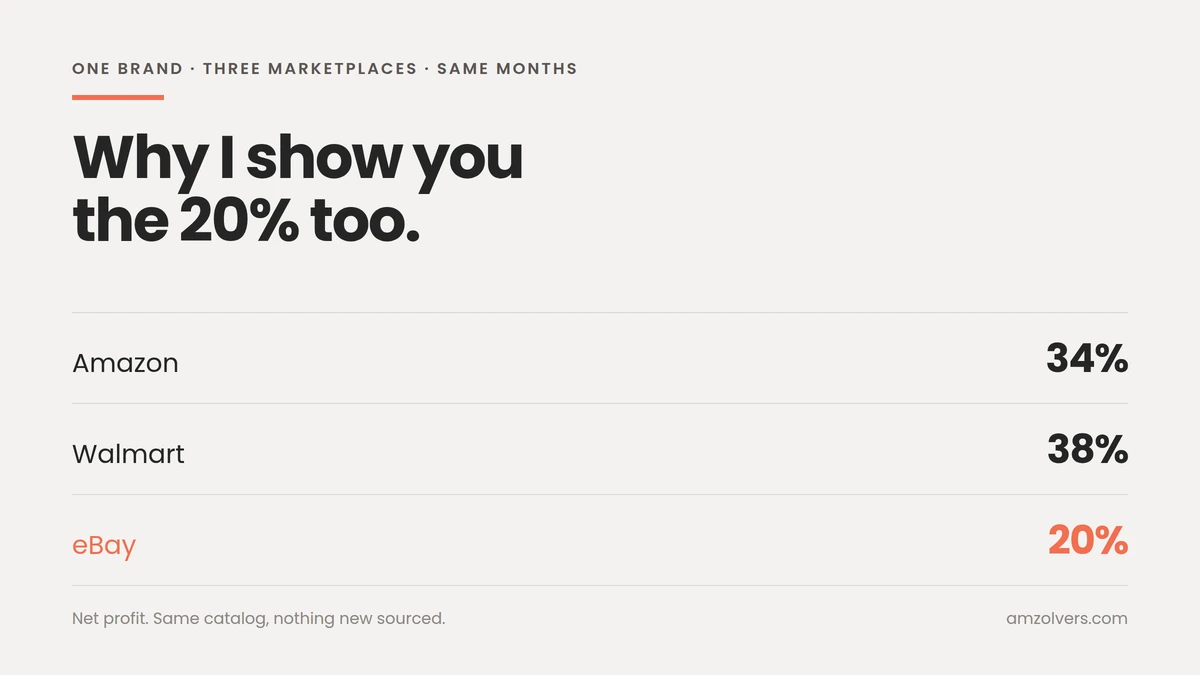
By month four the account closed at $129,000 with 38% net, and that was with five days out of stock.
Why the margin went up, not down
The instinct is that buying external traffic must be more expensive than buying internal traffic, so margin should fall. Two things stop that from happening.
First, off-marketplace clicks are usually cheaper than marketplace clicks for the same product, because you are not bidding against every other seller in your category for the same keyword.
Second, on Amazon there is the Brand Referral Bonus, which pays you back roughly ten percent of sales on traffic you send in from outside. It is not automatic. You have to set up Attribution tags and route the traffic through them. Plenty of brands run external traffic and never claim it, which is the cheapest money on the platform sitting untouched.
How to measure it so the number means something
This is where most external traffic experiments die. The traffic runs, sales go up a bit, nobody can prove why, and the budget gets cut.
- Use Amazon Attribution tags on every external link. Without them you are guessing. With them you get clicks, detail page views, add to carts, and purchases per source.
- Watch branded search volume, not just sales. External traffic often shows up first as more people searching your brand name on the marketplace. If branded search is climbing, it is working, even before the attributed sales look impressive.
- Watch organic rank on your main keyword. External traffic that converts pushes rank, and rank brings sales you never paid for. Attribution will never credit those to the campaign, so you have to look.
- Give it a full inventory cycle before you judge it. Thirty days is not enough to see the second and third order effects.
Where it goes wrong
Sending traffic to a listing that does not convert. This is the expensive one. External clicks cost real money and a page that converts at 8% will burn through the budget with nothing to show. Fix conversion first, always.
Not planning inventory for it. When external traffic lands it does not land gently. We have had months where the answer was back to back air shipments because a campaign worked faster than the ocean freight schedule. Running out of stock in the middle of it wastes the demand and the rank you just bought.
Treating it as a launch tactic. It is not. External traffic works best on a product that already sells, already converts, and has simply run out of room on the platform.
If your ad spend is climbing faster than your revenue and you have never run traffic from outside the marketplace, that gap is usually where the next stretch of growth is sitting.