Go and check what your landed cost did in dollars over the last 18 months.
Not what your supplier quoted you. What you actually paid.
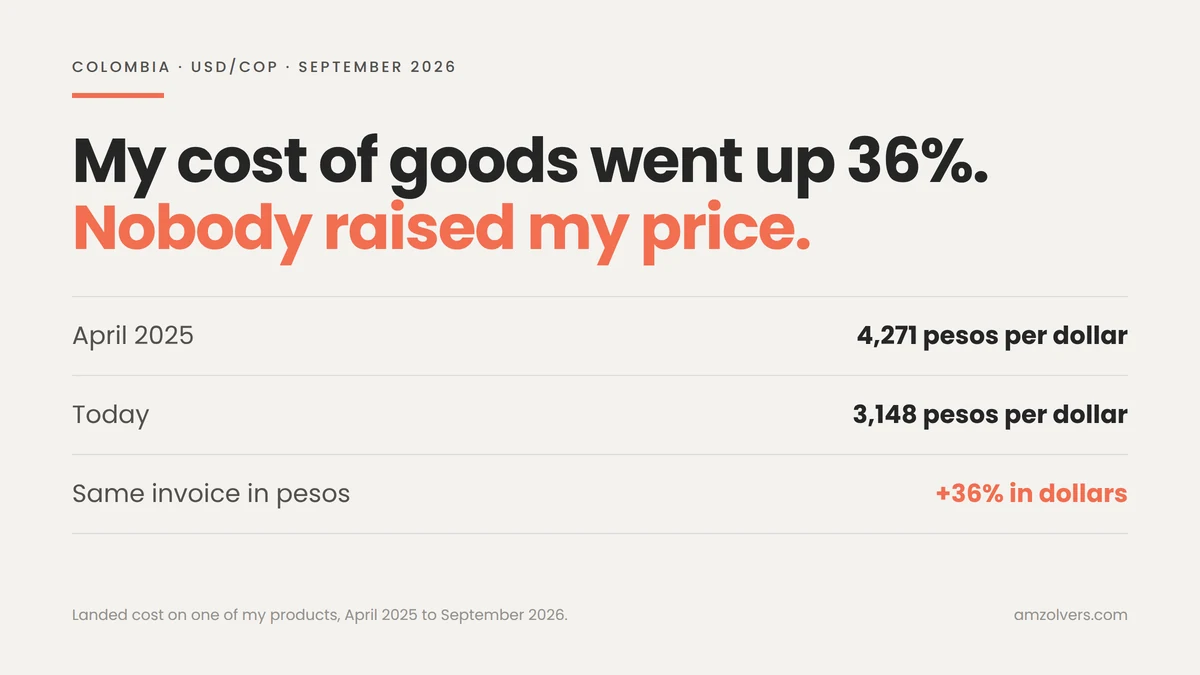
Mine went up 36%, and the quote never changed.
Nobody sends an email when this happens
I source one of my own products from Colombia and I pay the supplier in Colombian pesos.
In April 2025 a dollar bought 4,271 pesos. Today it buys 3,148.
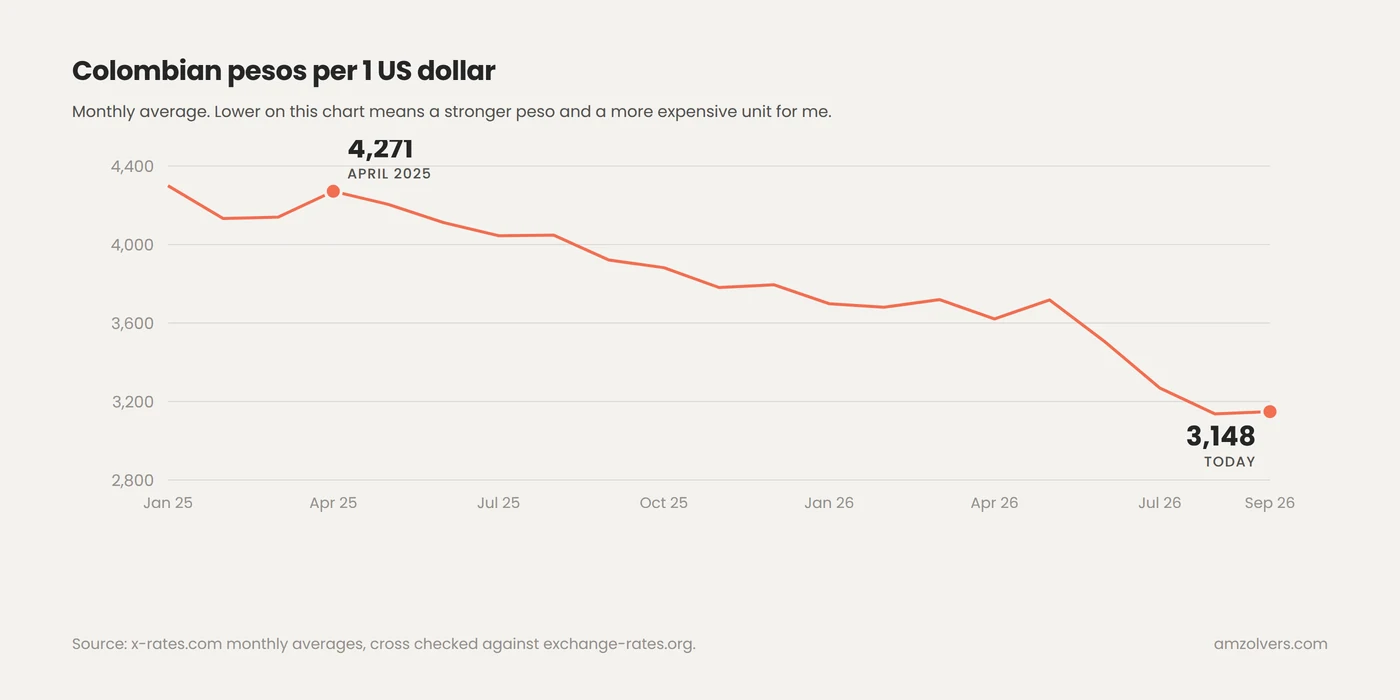
Same supplier, same spec, same number on the invoice. The dollar just buys less of it.
The peso has been the strongest performer in its region this year. Colombia’s central bank points at lower country risk after this year’s elections, firm oil prices, and interest rates high enough to keep pulling money in. None of that is my business. All of it is on my P&L.
Most of the move is recent, which is why it caught me. From April 2025 to May 2026 my cost crept up about 15%. June to August 2026 alone added another 21.
What it did to one $39.99 unit
April 2025. Landed cost $15.99. Amazon fees $12.00. I kept $12.00, a 30% margin before ads.
Today. Landed cost $21.70. Amazon fees $12.00. I keep $6.29, a 15.7% margin before ads.
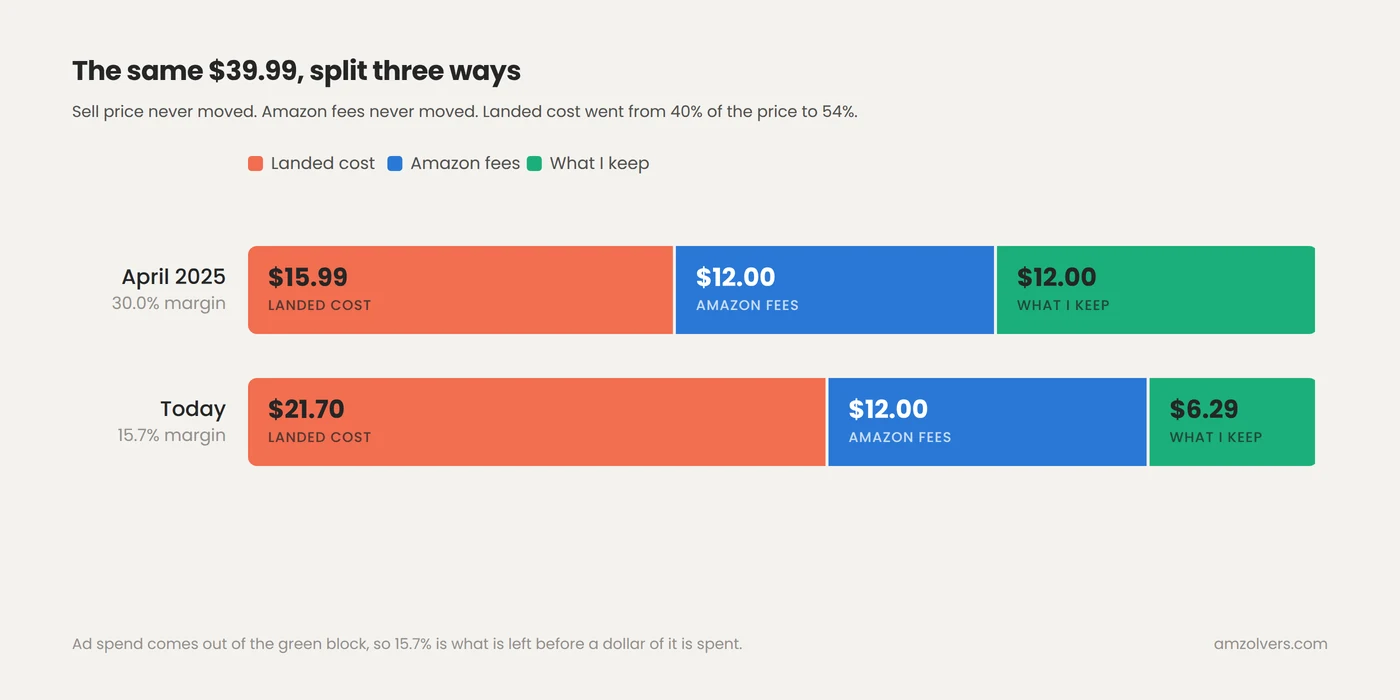
$5.70 a unit. 14 points of margin. Landed cost went from 40% of the sell price to 54%.
The price on Amazon has not moved once.
15.7% is before ads, and that is the number that decides everything
This is the part that gets missed when people look at a currency chart and shrug.
A 30% margin carries a normal TACOS without much thought. You spend, you take the ACOS hit, there is still something at the bottom. At 15.7% the same ad spend takes most of what is left, and the account stops being a growth problem and becomes an arithmetic one.
So the trigger for repricing is not the COGS line. It is margin before ads, because that is the pool ad spend comes out of. Watch that number and you will know you have run out of room long before anyone else tells you.
Paying in dollars does not protect you, it puts you later in the queue
Most sellers reading this pay their supplier in dollars and file this under somebody else’s problem.
It is not. Your supplier’s costs are in their currency. Their labour, their materials, their rent. When their currency strengthens against the dollar, the dollars you send buy less at home and their margin gets squeezed instead of yours.
That does not stay their problem. It reaches you as a higher quote on the next PO instead of a higher invoice this month. You get a lag, not immunity. And because it arrives as a negotiation rather than an exchange rate, it is easy to file as a supplier being difficult instead of what it actually is.
Why I have not raised the price
Raising price on Amazon is not a price change.
It is a conversion rate change first. Then a rank change, because conversion rate feeds rank. Then an ad account that costs more to run, because you are bidding for placements you used to earn.
To keep the same dollars per unit I would need to go from $39.99 to $46.70. To get the 30% margin back, $50.36. Both are real moves on a listing that spent two years earning its position.
So far, absorbing the points has been cheaper than paying to win the rank back. That calculation is close now, and it is the thing I am actually deciding. Not whether the peso turns around.
What I would go and check this week
Pull your landed cost from 18 months ago. Not the quote. The amount that actually left your account, converted at the rate you actually paid.
Then work out what your margin before ads is today with that number in it, rather than the number in the spreadsheet from when you launched.
Most of us audit ACOS every week and treat COGS as a constant. Mine moved 36% while I was watching the other line.
What did yours do?