You have heard all of this before.
Do not put more than five keywords in a campaign. Target high intent and low intent keywords separately. Keep broad and phrase match in different campaigns.
All of it is good advice. Almost nobody tells you why, so it gets followed as ritual, and rituals get abandoned the first time an account looks messy.
There are only two reasons behind every one of those rules. Control over placements, and giving every keyword a fair chance to spend.
Budget is won by the biggest keyword in the campaign
Take a real pair of terms in supplements.
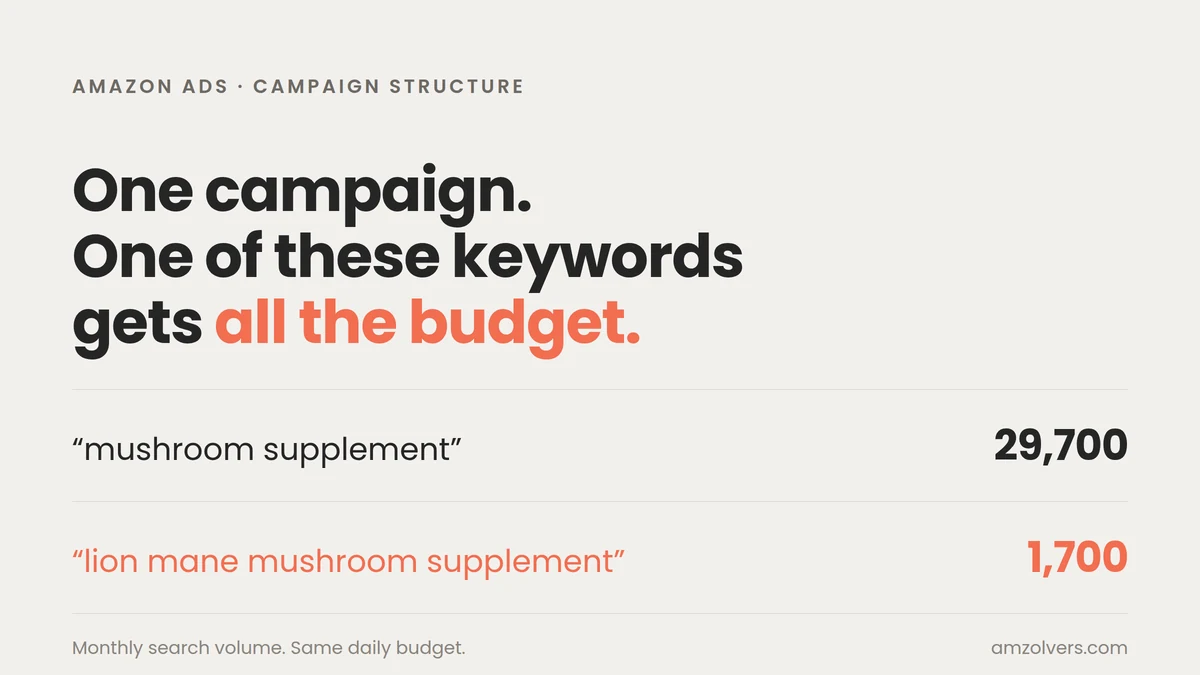
“mushroom supplement” has around 29,700 searches a month. “lion mane mushroom supplement” has around 1,700.
Put both in one campaign and you have not built a campaign with two keywords in it. You have built a campaign for “mushroom supplement” that happens to contain a second keyword.
The head term gets impressions all day. It collects the clicks. It spends the daily budget, usually before the afternoon. The long tail term gets whatever is left, which some days is nothing at all.
Then you look at the data a month later and conclude that “lion mane mushroom supplement” does not work. It never got the chance to work. It got 40 clicks while the other one got 900, and 40 clicks is not a verdict on anything.
That is the whole problem. Not bad keywords. A budget that was never divided.
You cannot change placement for one keyword
This is the second half, and it is the part that makes segmentation structural rather than cosmetic.
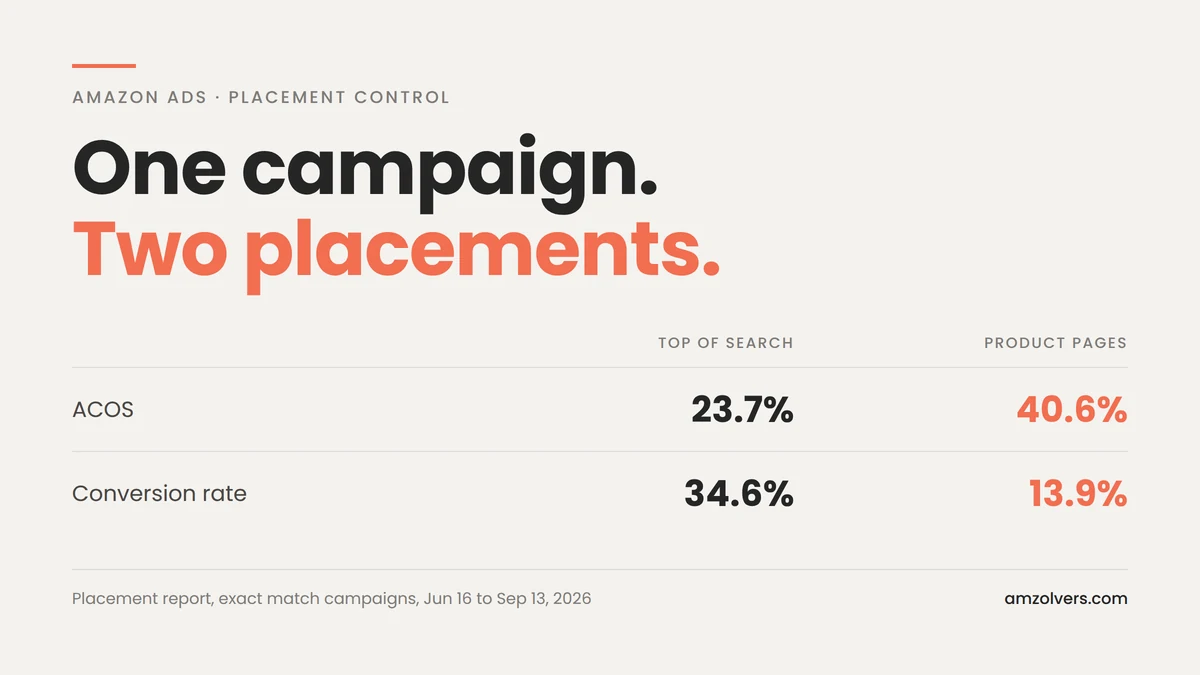
Placement adjustments, the ones that push more spend to top of search or product pages, are set at the campaign level. There is no keyword level placement control. There never has been.
So if a campaign holds one keyword that deserves an aggressive top of search modifier and another that only ever converts on product pages, you cannot serve both. Whatever you set is wrong for one of them. You end up choosing which keyword to underserve, and usually you do not even realise you are choosing.
The only way to get placement control per keyword is to give that keyword, or that small group of keywords, its own campaign.
Segment by search volume first
Match type and intent get all the attention. Search volume is the split that actually protects your budget, and it is the one most accounts skip.
The rule is simple: keywords in the same campaign should sit in the same range of search volume.
Group your head terms together. Group your mid tail together. Group your long tail together. Inside each campaign the keywords are now competing for budget on roughly even footing, so what you learn from the data is about performance rather than about which term happened to be more popular.
Then keep the keyword count low. Five is not a magic number, it is just small enough that no single term can quietly eat the campaign, and small enough that a placement setting is a real decision rather than a compromise.
What that looks like in practice
- Pull search volume for every keyword you plan to run. Not estimated relevance, actual volume.
- Sort them and cut the list into bands. Head, mid, long tail. The exact boundaries matter less than the fact that the gap inside a band is small.
- Build one campaign per band, with a handful of keywords in each.
- Split match types across campaigns rather than stacking them in one. Broad will always outspend exact on the same term, for exactly the reason above.
- Set placements per campaign now that you can. Head terms usually earn top of search. Long tail often converts better on product pages for less money.
- Set budgets per campaign and read the results per campaign. A long tail campaign that spends its full budget every day is telling you something a starved keyword never could.
Where it goes wrong
Splitting so far that nothing gets data. Twenty campaigns with a $5 daily budget each will all sit at three clicks a day and none of them will ever reach significance. Segmentation costs budget, because each campaign needs enough to actually test. If you cannot fund the structure, run fewer keywords, not smaller budgets.
Treating the structure as permanent. Search volume moves with the season. A term that sat in your mid tail band in October can be a head term in December. Re-band at least quarterly.
Segmenting and then never using the control you bought. If every campaign has the same placement modifiers and the same bid strategy, you have taken on the admin of a segmented account and none of the benefit. The split is only worth anything if the settings differ afterwards.
Good segmentation is not tidiness. It is the only way to make sure that every keyword you are paying for is given enough budget to prove itself, and that you can put its spend where that keyword actually converts.
If a keyword in your account has never had a fair share of a budget, you do not know yet whether it works.